You're scrolling LinkedIn during your lunch break when you see it: your biggest competitor just launched the exact feature you've been building for the past three months. Your stomach drops. What now?
This is the reality of being a solo founder. You're shipping product, closing deals, managing support, AND supposed to keep tabs on five competitors who each have 10x your team size.
How are you supposed to track competitors when you're also writing code, answering support tickets, and somehow finding time to tweet about your product?
Here's the truth: You need competitive intelligence. But you're a team of one.
This is the solopreneur's competitive intelligence dilemma, and this guide will show you how to solve it.
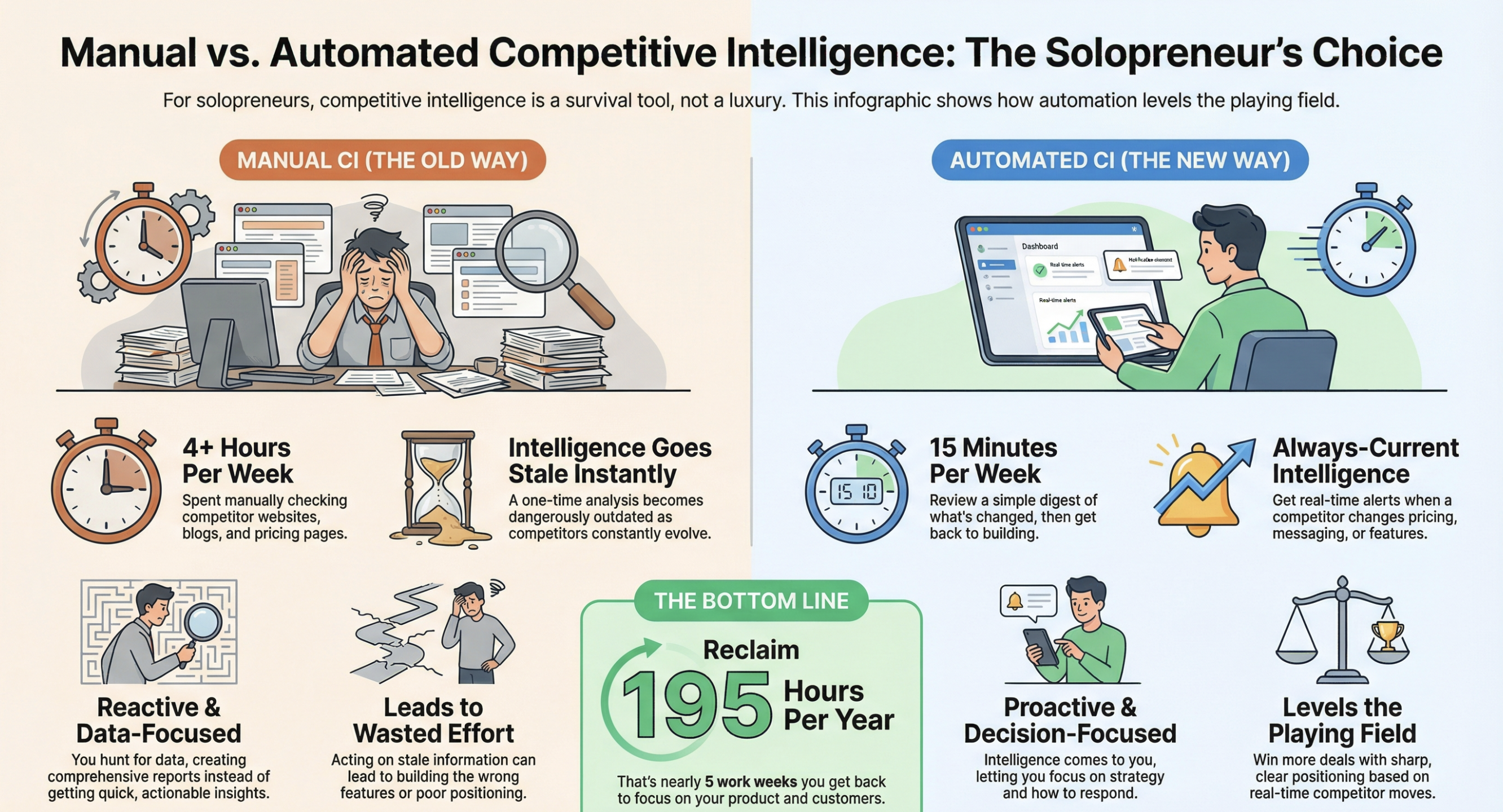
The Solopreneur's Competitive Intelligence Dilemma
Let's be honest about what you're up against.
You're competing against funded companies with dedicated teams. They have CI analysts, PMMs, marketing teams, and sales ops. You have yourself. They can dedicate 40 hours per week to competitive research. You have maybe 2-3 hours per week (if you're lucky).
You don't have time for manual competitive research. Your time breaks down something like this: building product (40%), talking to customers (30%), marketing and sales (20%), admin and ops (10%). Where does CI research fit? Something always takes priority - usually customer calls or product bugs.
The Solopreneur's Time Allocation Problem
But here's the paradox: you need CI more than anyone.
Direct competitor comparisons happen daily in your sales calls and investor meetings. Prospects ask "What makes you different from Competitor X?" every single time. Your positioning and product decisions directly impact revenue, and with limited resources, every choice matters exponentially. One wrong positioning decision or building the wrong feature equals months of wasted effort.
Most founders fall into what I call the "one-time CI exercise" trap. They do competitive research once during launch or early validation. They create a competitive slide in their pitch deck - you know, the 2x2 quadrant with your logo in the top-right corner. Then they call it done and abandon it.
The problem? Competitors keep evolving, but your intelligence doesn't. Your 6-month-old competitive analysis is now dangerously outdated. You're selling based on stale intelligence.
I've seen this pattern countless times. The hard part isn't knowing where to look - it's keeping everything current without it becoming a full-time job. Great insights exist everywhere: websites, reviews, social media, news. But stitching it all together manually doesn't scale. You either spend 10+ hours per week on CI, or you let it go stale. Neither option works for a solo founder.
And the traditional CI playbook? It's built for companies with resources you don't have:
- "Hire a CI analyst" - you can't afford a $120K-200K salary
- "Set up weekly competitor tracking meetings" - you're the only one in the meeting
- "Use enterprise CI tools" - $30K-100K/year budgets don't exist for you
- "Work with a consulting firm" - you don't have the budget for it
I've seen founders treat CI as a one-time exercise early on, then abandon it due to complexity and time required. Well, their competitors keep making moves and evolving, so should their intelligence. We're building Signal Labs to automate some of this manual research, mostly because we ran into the same scaling problem ourselves.
So what does competitive intelligence look like when you're a team of one?
What Solopreneurs Actually Need from Competitive Intelligence
Here's what I learned after years of watching solo founders struggle with CI: they need something fundamentally different from what enterprise CI teams build.
Fast, not comprehensive. You don't need 20-page competitor reports. You need "What changed this week?" in 5 minutes. Focus on competitive signals that impact immediate decisions. For solopreneurs, speed beats depth every time. When your competitor launches a new pricing tier, you need to know in 24 hours, not next quarter.
Actionable, not analytical. Skip the deep-dive analysis and market research. What you need is: "Competitor X launched Y feature - here's how to respond." Focus on what to do, not just what to know. Position recommendations, not data dumps. For example: "They're positioning as 'enterprise-grade' - you can position as 'enterprise power without enterprise complexity.'"
Automated, not manual. You can't spend 10 hours per week tracking 5 competitors manually. You need automated monitoring and alerts. Intelligence should come to you, not require you to hunt for it. Set it and forget it until something actually changes. Instead of manual Friday website checks, get a Slack alert the moment a competitor changes their pricing.
Decision-focused, not just data-focused. Solopreneurs need differentiation clarity and smart product decisions, not just competitor data. "Why us vs. them?" and "What should we build next?" - these questions drive every sales conversation and roadmap decision. Understanding competitor feature gaps helps you find opportunities they're missing. One clear differentiator beats ten generic features. You can't out-feature a well-funded competitor, but you can out-position them and build smarter.
Here's the key insight: Enterprise CI teams optimize for completeness. Solopreneurs optimize for speed and focus. You don't need to know everything about your competitors - you need to know the 3 things that help you win deals.
Consider two approaches to CI:
Enterprise approach: Spend 20 hours researching Competitor X, create comprehensive battlecard, present to sales team.
Solopreneur approach: Automated competitor monitoring alerts you to Competitor X's new pricing → 5-minute analysis → update your positioning doc → back to building.
You need the second approach.
The Solopreneur's CI Toolkit: What to Track (and What to Ignore)
Not all competitive intelligence is created equal. Here's what actually matters when you're a small team.
TRACK (High Impact)
- Positioning changes - Website updates
- Pricing updates - Plans & packages
- Product launches - Features & integrations
- Customer sentiment - Reviews & feedback
IGNORE (Low ROI)
- Earnings calls - Too high-level
- Org chart changes - Not actionable
- Funding news - Interesting but not useful
- Industry reports - Too generic
Key principle: If it doesn't help you win deals or make product decisions, skip it.
Track These 4 Things (and Automate Them)
1. Competitor Positioning & Messaging Changes (Weekly)
Track homepage headline shifts (signals repositioning), value prop evolution (are they moving upmarket or downmarket?), target audience changes (who are they going after now?), and key differentiators they're emphasizing.
Why it matters: Positioning changes happen before product changes. Catching repositioning early gives you time to adjust your own positioning proactively.
How to automate: Use website change monitoring tools like CIx for automated competitor monitoring, RSS feeds for competitor blog posts, and email alerts for homepage changes.
Real example: Your competitor changes their homepage headline from "CRM for Small Businesses" to "CRM for Growing Teams." This signals they're moving slightly upmarket, targeting companies with 20-50 employees instead of solopreneurs. You can now double down on positioning as "built for solo founders and small teams under 10" - capturing the audience they're leaving behind.
2. Pricing & Packaging Updates (Monthly)
Track pricing page changes (new pricing, plan changes), new plan tiers (adding enterprise tier? removing free tier?), feature moves between tiers (what's now gated?), and payment terms and discount strategies.
Why it matters: Direct impact on your pricing decisions and competitive positioning. If a competitor raises prices, you have a positioning opportunity. If they drop prices, you need to know immediately.
How to automate: Wayback Machine alerts for pricing page changes, pricing page monitoring (CIx tracks this automatically), and quarterly pricing page screenshots for comparison.
Real example: Your competitor adds a $299/month "Pro" tier between their $99 Starter and $999 Enterprise plans. You now know there's demand for mid-tier pricing, and you can position your $199 plan as better value.
3. Product Announcements & Launches (Real-time)
Track new feature releases and product launches, integration partnerships (what tools are they integrating with?), product roadmap hints (beta announcements, hiring signals), and sunset announcements (what are they killing?).
Why it matters: Prospect questions spike immediately after competitor launches. Plus, seeing what competitors are building (and not building) helps you make smarter product decisions and prioritize your roadmap. You need to know in hours, not next week.
How to automate: Email alerts for competitor blog RSS feeds, social media monitoring (LinkedIn company pages, Twitter), and Product Hunt alerts when competitors launch.
Real example: Your competitor announces a Salesforce integration. You get an alert within 30 minutes, check your sales pipeline for prospects using Salesforce, and proactively reach out with your integration roadmap or workaround. Bonus: This tells you there's demand for this integration - it just moved up your product roadmap.
4. Customer Sentiment & Reviews (Monthly)
Track G2, Capterra, and TrustRadius reviews (especially 3-star and below), Reddit and Twitter mentions and complaints, common complaint patterns (what do customers consistently dislike?), and common praise patterns (what are they winning on?).
Why it matters: Reveals positioning opportunities, competitive weaknesses, and product gaps. Negative reviews equal your differentiation opportunities and feature ideas. Positive reviews show areas where you need to compete or position differently. Customer complaints about competitors often reveal what you should build next.
How to automate: Review monitoring tools (track new reviews), social listening tools (limited free options: Google Alerts for "[competitor] review"), and monthly manual check (30 minutes: scan latest 20 reviews).
Real example: Your competitor's G2 reviews consistently mention "great features, but terrible onboarding and support." You position as "powerful features + white-glove onboarding" - turning their weakness into your strength. And you prioritize building better onboarding flows into your product roadmap.
Ignore These (They Create Noise and Waste Time)
Quarterly earnings calls - Unless they're public and in your exact market segment, earnings calls are too high-level. Focus on product and positioning changes, not revenue numbers.
Org chart changes - New VP of Sales hired? Doesn't impact your positioning this month. Ignore until it affects product or pricing.
Funding announcements - Interesting for morale ("they raised $50M!"), but not actionable for day-to-day competitive positioning.
Broad industry trend reports - Gartner Magic Quadrants and Forrester Waves are useful for enterprises, less relevant for solopreneurs. Too high-level, too infrequent.
Key principle: If it doesn't help you answer "What makes us different?", "How do I respond to this competitor objection?", or "What should we build next?" in the next sales call or product decision, skip it.
Ready to automate competitor tracking? Start free →
How to Use CI When You're Selling, Building, and Researching Simultaneously
The secret to sustainable CI as a solopreneur? Integration, not addition.
Integrate CI into existing workflows - don't create new ones. Don't add "Friday afternoon competitor research" to your calendar. Set up Slack or email alerts to monitor while you work (passive monitoring). Use CI when preparing for sales calls (just-in-time research, not proactive research). Make CI a byproduct of your existing work, not a separate task.
Here's what this looks like in practice: Check weekly CI digest when you have time (5 min). Sales call prep: quick competitor check, refresh your knowledge, decide on talking points (3-4 min). Competitor alert in Slack: read and decide if action needed (1 min). Total time: 15-20 minutes per week.
Build a simple competitive positioning doc - not a battlecard. Create a one-pager: "Why Us vs. [Top 3 Competitors]." List 3 key differentiators per competitor (not 10). Update monthly or when major changes happen. Keep it simple enough to remember during live sales calls - you won't have time to reference docs mid-call. Store it where you'll actually use it - even Notes app is better than a Google Drive folder you never open.
Here's a simple template structure:
Competitor X
They say: "Enterprise-grade security and compliance"
We say: "Enterprise security without enterprise complexity"
When to use: Prospect mentions they're "between us and Competitor X"
Objection handling: "Yes, they're built for 1000+ person companies. You're 50 people. Do you want enterprise complexity or enterprise security with startup speed?"
Use competitive intelligence to sharpen positioning - not just respond to questions. Move from reactive CI ("Prospect asked about Competitor X, better research them") to proactive CI ("Competitor X is emphasizing enterprise security. I can position as security without complexity").
Turn their strengths into positioning opportunities using what David B. Yoffie calls Competitive Judo in his book Judo Strategy: Find their core positioning, identify the inherent tradeoff or weakness in that positioning, position yourself as the opposite (better for certain customers).
Example: "All-in-one" strength is "Does everything" but the weakness is "Master of none." Your positioning: "We only do X, but we do it better than anyone."
Leverage async competitive research. Use AI tools to summarize competitor changes (ChatGPT + URL = summary). Automate competitor monitoring reports (weekly digest email). Focus your limited time on interpretation, not data collection. Delegate to AI: data collection. You handle: strategic decisions.
As a solo founder, I used to spend 3-4 hours every Sunday manually checking 5 competitor websites, pricing pages, and blogs. After automating competitor monitoring with CIx, I get a 15-minute weekly digest with only the changes that matter. That's 3-4 hours back in my week - time I now spend shipping product and talking to customers.
When to Invest More in Competitive Intelligence (As You Scale)
CI sophistication should scale with team size, not before. Here's what that progression looks like:
Solopreneur stage (0-1 employees): What you need is automated monitoring plus a simple positioning doc. Time investment: 15-20 minutes per week. Tools: CIx, Google Alerts, simple spreadsheet. Output: "Why us vs. them" one-pager.
Early team (2-5 employees): What changes: You add your first sales hire, and they need competitive talking points. New need: Simple battlecards (1 page per competitor). Time investment: 1-2 hours per week. Who owns it: Founder or marketing hire.
Growing startup (5-15 employees): What changes: Marketing hire joins, needs competitive content and positioning. New need: Competitive blog posts, sales collateral, positioning strategy. Time investment: 5-10 hours per week. Who owns it: Marketing or PMM hire (part-time).
Scaling startup (15-50 employees): What changes: Multiple sales reps need scalable CI enablement. New need: Structured CI program, real-time battlecard updates, competitive training. Time investment: Full-time role. Who owns it: Dedicated PMM or CI analyst.
Signals you need to level up CI:
- Sales reps asking competitive questions you can't answer quickly
- Losing deals to competitors you don't track
- Customer questions about competitors you haven't researched
- Multiple team members asking "What do we know about Competitor X?"
- Your positioning doc is 6+ months old
What changes at each stage: From solopreneur to small team, automate monitoring and create basic battlecards. From small team to growing startup, hire a PMM part-time for competitive content. From growing to scaling startup, hire dedicated CI or PMM full-time. From scaling to enterprise, build a full CI program with multiple team members.
Key insight: Don't build enterprise CI infrastructure when you're a team of one. Match your CI investment to your team size. Automate first, hire later.
Tools & Resources for Solopreneur Competitive Intelligence
Here's the toolkit that actually works for solo founders:
Automated Competitor Monitoring
CIx (Recommended for solopreneurs): Real-time competitor tracking across websites, pricing, features. Automated battlecard generation (60 seconds vs. 20 hours manual). Multi-source intelligence aggregation. Designed for lean teams (not enterprise complexity). Startup-friendly pricing. Use case: Set it up once, get weekly digests, only act when something changes.
Google Alerts (Free, limited effectiveness): Free email alerts for competitor mentions. Limited to publicly indexed content. High noise-to-signal ratio. Shows you what happened but doesn't tell you how you should act on it. Use case: Better than nothing, but requires significant manual filtering.
Visualping (Website change tracking): Monitors specific pages for changes. Email alerts when pages change. Requires manual setup for each page. Use case: Good for tracking pricing pages if you only have 2-3 competitors.
Competitive Intelligence Aggregation
Feedly (RSS feed aggregation): Aggregate competitor blogs in one place. Set up once, check daily or weekly. Use case: Stay on top of competitor announcements without checking 5 different blogs.
Review monitoring: Set up email alerts for new competitor reviews on G2, Capterra, and TrustRadius. Free for most review platforms. Use case: Monthly review scan to identify positioning opportunities.
Time-Saving Principles
- Automate data collection, focus your time on interpretation - Tools collect data (automated). You make strategic decisions (manual). Don't confuse the two.
- Monitor only the competitors that impact your deals - Not all 20 competitors matter. Focus on the 3-5 that prospects mention most. Ignore the rest until they become relevant.
- Track changes, not static information - Don't re-research competitors every week. Only track what changed since last week. Reduces research time by 80%.
- Use AI to summarize and digest competitive intelligence - Feed competitor updates and questions to CIx. Use AI for data processing, human judgment for strategy.
Budget-Friendly Approach
Getting started: Start on the free CIx plan — one competitor tracked as a living page, no credit card — or use Google Alerts plus manual website checks. Time investment: 15-20 minutes per week.
Growing tier: A CIx Team plan once one competitor stops being enough, scoped to the set you actually track. Time investment: 1-2 hours per week.
Enterprise tier: CIx Enterprise plan for advanced needs (custom integrations, SSO, dedicated support, monthly CI strategy consulting calls). Time investment: Full-time CI role(s).
Recommendation for solopreneurs: Start free with CIx, scale as you grow. Your time is worth more than manual research.
The Time Savings Calculator
See how much time you get back with automated CI
Competitive Intelligence as a Competitive Advantage for Solopreneurs
Here's what most people don't realize: most solopreneurs ignore CI entirely. "I don't have time" is the default response. Positioning suffers, deals are lost to better-prepared competitors, lack of differentiation clarity leads to commodity pricing pressure.
This is your opportunity. Be one of the few solo founders with sharp competitive positioning.
Automated CI levels the playing field. You can track competitors as effectively as funded startups. Intelligence quality beats team size. Automation removes the "I don't have time" excuse. A well-funded competitor with poor CI will lose to a solo founder with automated CI.
Positioning clarity is your superpower. Funded startups often have bigger teams but fuzzy positioning. "We're an all-in-one platform for everyone" equals no differentiation. Solo founders with sharp positioning win deals against bigger competitors. Clear differentiation equals higher win rates and better pricing power.
According to industry research, B2B SaaS companies with clear differentiation achieve 3x higher win rates in competitive deals.
You're closer to customers than big competitors. Use competitive intelligence plus direct customer conversations to sharpen positioning. Iterate faster than competitors with big teams and slow decision-making. Your agility plus automated CI equals competitive advantage.
Here's a positioning example: Your big competitor says "We're the leading enterprise marketing automation platform." You say: "We're marketing automation for B2B SaaS startups - enterprise power without enterprise complexity." You win the startup segment while they're stuck chasing enterprises.
Remember scrolling LinkedIn and discovering your competitor launched that feature? With automated CI, you'd have been alerted the moment it happened, with a summary of what changed and how to respond. That's the difference between reactive and proactive competitive intelligence - and it's the difference between losing deals and winning them.
Your Next Steps
Let's recap what we've covered.
CI for solopreneurs is about focus, automation, and positioning - not comprehensiveness. You don't need enterprise tools or dedicated teams. Automate monitoring, sharpen positioning, win more deals. Competitive intelligence is not a luxury for funded startups - it's a survival tool for solopreneurs.
The transformation looks like this: Before, you spent 10+ hours per week manually checking competitors OR ignored CI entirely. After, you spend 15 minutes per week with automated monitoring and always-current intelligence.
What's possible with the right approach? You can compete with well-funded competitors on positioning, not budget. You can win deals because your differentiation is clearer than theirs. You can make smarter product decisions by understanding what competitors are building (and not building). You can scale your intelligence as you scale your company.
You're competing with giants. Level the playing field with automated competitive intelligence built for founders like you.
Ready to Track Competitors in 15 Minutes Per Week?
Start with automated competitor monitoring designed for solo founders. No enterprise complexity, no dedicated CI team required.
More Reads on Competitive Intelligence
Competing in Real Time
A CI playbook for high-growth teams scaling competitive intelligence
Read more →The CI Treadmill is Broken
Generate battlecards in 60 seconds instead of 2 weeks
Read more →Sales Enablement Battlecards
From static docs to real-time competitive intelligence that sales teams trust
Read more →