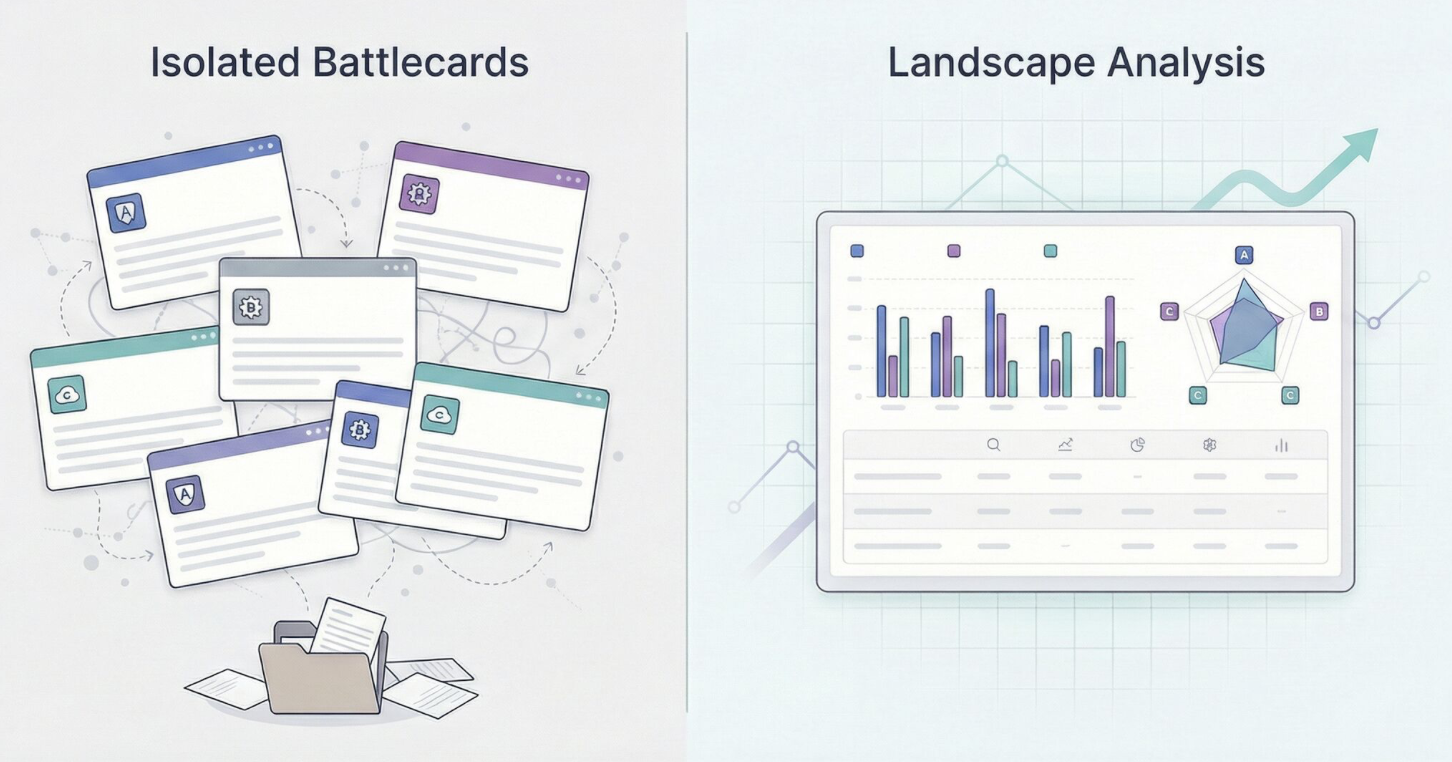
Most competitive intelligence workflows are built around one idea: create a battlecard for Competitor A, repeat for B, C, D… and then try to mentally stitch it all together. That’s fine for a 1v1 deal. It breaks the moment you need to understand the full market.
If your category has 10+ real players, you need a better way to do competitive landscape analysis - one that turns scattered research into a clear view of the market and the moves you should make next.
That’s why we built Landscape Analysis: a single view where you can analyze 10+ competitors at once with positioning, comparisons, and market gaps - without building 10 separate documents.
What is competitive landscape analysis?
Competitive landscape analysis is the process of understanding how companies in a market compare across positioning, capabilities, audience focus, and go-to-market strategy - so you can make better decisions in product, marketing, and sales.
It helps teams answer questions like:
- Who are we actually competing with (and who’s just adjacent)?
- What’s becoming table stakes across the category?
- Where are the market gaps customers still complain about?
- Which competitor narratives are winning and which are fading?
The problem with isolated battlecards
Battlecards are useful. They give you depth for a specific competitor. But they’re not designed for market-wide clarity.
When your research lives as separate “Competitor A / Competitor B” docs, you end up with:
- Inconsistent comparisons (different structure, different depth, different sources)
- Slow updates (updating 10 docs is a project, not a habit)
- No synthesis (patterns across the market stay hidden)
- Harder communication (leadership wants a landscape, not a folder)
In other words: you don’t just need more intel - you need faster synthesis.
Landscape Analysis: compare 10+ competitors in one view
Landscape Analysis is built for teams who need to understand the full competitive landscape - not just 1v1 comparisons.
With one comprehensive view, you can generate:
1) One landscape view (the full market, at a glance)
See multiple competitors together so you can spot patterns quickly: clusters, category leaders, niche players, and where you stand.
2) A market positioning map with all players
Positioning becomes easier to communicate when it’s visual. A map helps you align leadership, product, and GTM on what matters and where you can credibly differentiate.
3) Side-by-side feature comparisons
Instead of guessing, compare capabilities with a consistent lens - so you can identify what’s table stakes, what’s differentiated, and what’s overhyped.
4) Collective strengths, weaknesses, and threats
A single competitor SWOT is helpful. A market-wide synthesis is better. Landscape Analysis helps you see recurring strengths you must counter, repeated weaknesses you can exploit, and emerging threats to prepare for.
5) Clear market gaps & opportunities
When you view competitors together, gaps become obvious: underserved segments, missing features, and crowded narratives you should avoid.
Who it’s for (and when to use it)
Landscape Analysis is especially useful for:
- Market entry & GTM planning: understand the playing field before you pick your wedge
- Product strategy & positioning: prioritize the roadmap and define your differentiation
- Sales training & enablement: arm sellers with a clear, consistent market narrative
If you’re running competitor monitoring, building battlecards, or updating enablement, this becomes a “single source of truth” view that makes everything else faster.
A simple workflow teams follow
Most teams use Landscape Analysis in a loop:
- Select the market + competitors you want included (10+ is common)
- Generate the landscape: map + comparisons + synthesis
- Turn it into decisions: positioning, messaging, priorities, and risks
- Operationalize: update your positioning doc, sales enablement, and roadmap
Battlecards vs. landscape analysis (use both)
They’re complementary:
- Use battlecards when you need depth on a specific competitor in a deal.
- Use landscape analysis when you need breadth across many competitors for strategy, positioning, and GTM alignment.
FAQ
How many competitors should I include? Start with the competitors that show up most often in deals and buyer research. Then expand to adjacent and emerging players.
How often should I update a landscape analysis? Most teams refresh on a monthly cadence, with faster updates when big launches or pricing changes happen.
What makes this different from a spreadsheet? Spreadsheets track data. Landscape Analysis helps you synthesize: positioning, patterns, gaps, and the strategic moves to make next.
Ready to See the Full Market in One View?
Compare 10+ competitors, map the market, and find the gaps - without stitching together a dozen docs.
More Reads on Competitive Intelligence
Competing in Real Time
A CI playbook for high-growth teams scaling competitive intelligence
Read more →The CI Treadmill is Broken
Generate battlecards in 60 seconds instead of 2 weeks
Read more →Sales Enablement Battlecards
From static docs to real-time competitive intelligence that sales teams trust
Read more →